
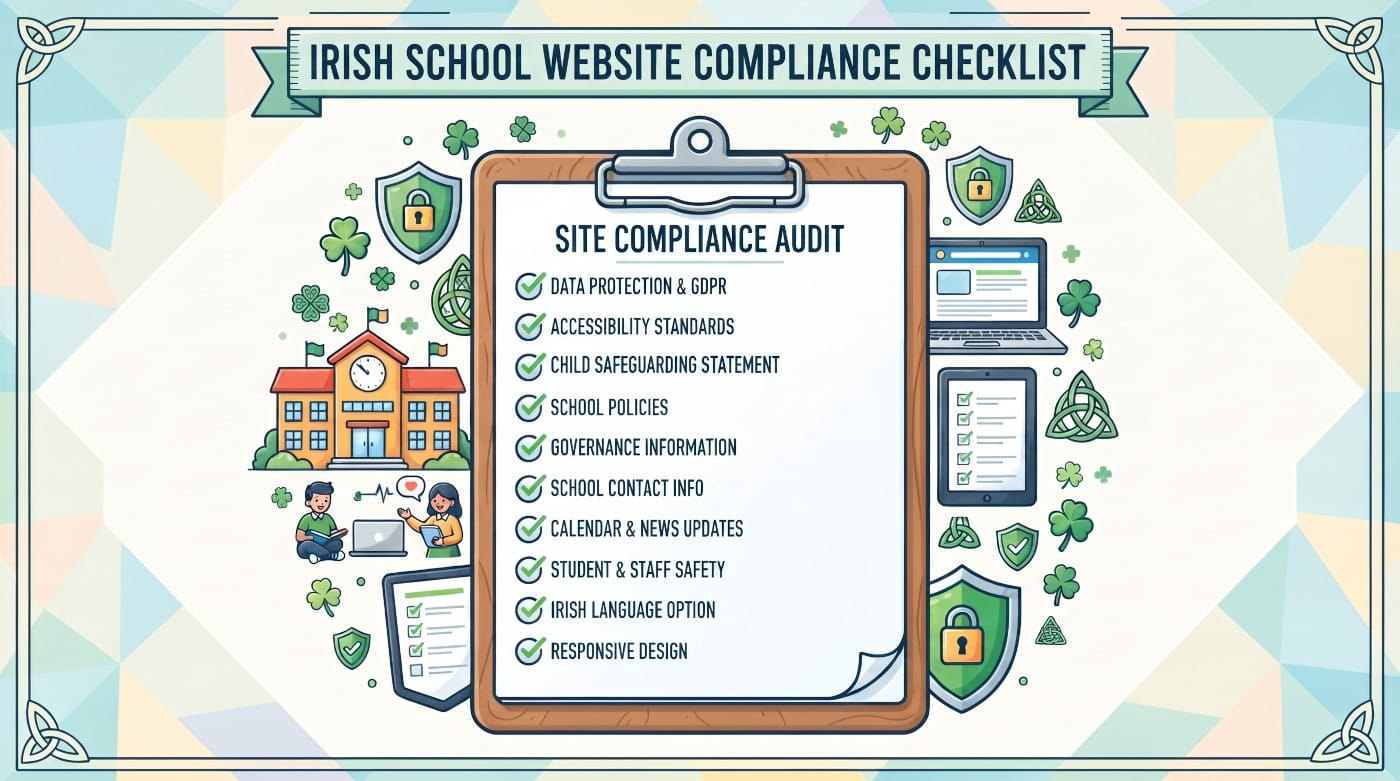
For primary and secondary schools across Ireland, school website compliance is an important consideration. A website is much more than a digital noticeboard. It’s an important communication resource for parents, pupils, teachers and the wider school community, as well as a central place for publishing important school information, policies, notices and documents.
Keeping this information accessible, up to date and easy to find is an important part of managing an effective school website. Working with an experienced school website design specialist can help ensure that your website is secure, accessible, easy to manage and designed around the needs of your school community.
Below is a practical checklist of important elements to consider when reviewing your school’s website.
1. Important Policies & Publications
Schools need to make a range of important information and policies available to parents, guardians and the wider school community. Your website should provide a clear and easy-to-navigate area where important documents can be accessed.
Depending on the school and the applicable requirements, these may include:
- Admissions Policy & Annual Admission Notice: Schools are required to publish their admissions policy on their website, while the Annual Admission Notice must be published in advance of the school’s annual admissions process.
- Child Safeguarding Statement & Risk Assessment: Schools and other relevant services have specific safeguarding obligations, including requirements relating to risk assessment and Child Safeguarding Statements.
- Anti-Bullying Policy: Important information relating to the school’s approach to preventing and addressing bullying should be readily accessible to the school community.
- Code of Behaviour: The school’s expectations and standards of behaviour should be clearly communicated and easy for parents and pupils to find.
- Data Protection & Privacy Information: Schools should provide clear information about how personal data is handled and protected.
A well-organised policies and documents section makes it much easier for parents to find important information without having to contact the school office.
2. Accessibility & Mobile Responsiveness
School website compliance also means considering accessibility, ensuring that school communication is accessible to as many members of the school community as possible. A significant amount of website traffic can come from smartphones and tablets, so a school website should work effectively across different screen sizes and devices.
Accessibility should also be considered throughout the design and content of the website. Clear navigation, readable text, appropriate colour contrast, descriptive alternative text for images and compatibility with assistive technologies can all help make information easier to access. WCAG (Web Content Accessibility Guidelines) provide widely used guidelines for improving web accessibility, including principles around perceivability, operability, understandability and robustness.
For schools, accessibility is particularly important because the website may be the first place parents look for essential information about their child’s education.
3. Easy Access to School Systems & Information
A good school website should make it easy for parents and members of the school community to reach the services and information they use regularly.
Useful features and links can include:
- School Management Systems: Clear links to platforms such as Aladdin or VSware can make it easier for parents to access the systems used by their school.
- Online Enrolment: Where applicable, schools can provide clear information and links relating to their admissions and enrolment processes.
- School Calendar: A regularly updated calendar can provide information about school closures, holidays, events, meetings and other important dates.
- News & Announcements: An easy-to-manage news area allows schools to communicate important updates to parents and the wider school community.
- Forms & Documents: Important forms, policies and documents should be easy to locate and download.
The aim is simple: parents should not have to search through several pages or contact the school office to find information that could be made readily available online.
4. Website Security & Ongoing Maintenance
A school website should not simply be designed and launched and then left unattended. Regular maintenance is important for keeping the website’s software up to date, reducing the risk of security vulnerabilities and helping to ensure that the website continues to function correctly.
Schools should also consider regular backups and who will be responsible for maintaining the website after it goes live. Software updates, security checks and backups can help protect the website and provide greater peace of mind.
It is also worth considering what happens when a school encounters a website problem. Having access to ongoing technical support can help ensure that issues are dealt with promptly rather than leaving the school to manage them alone.
5. Easy Content Management
A school website needs to be kept up to date throughout the school year. New announcements need to be published, events added to the calendar, documents uploaded and existing information updated regularly.
For this reason, a school website should include a straightforward Content Management System (CMS) that allows authorised members of staff to manage the website without needing technical knowledge or having to contact a web developer every time a small change is required.
An easy-to-manage website can save valuable time for school staff while ensuring that parents and the wider school community always have access to current information.
6. Clear Navigation for Parents & the School Community
A school website can contain a large amount of information, so its structure and navigation are extremely important.
Parents should be able to quickly find commonly requested information such as:
- School information and contact details
- Admissions and enrolment
- School policies
- News and announcements
- Calendar and upcoming events
- School holidays and closures
- Forms and documents
- Information for parents and pupils
- Links to online school systems
A clear menu structure and well-organised content make the website easier to use and reduce the amount of time parents and school staff spend searching for information.
7. Keep Your Website Information Up to Date
Even a well-designed school website can become ineffective if its information is outdated.
Schools should regularly review important pages and documents to ensure that information remains accurate and relevant. This is particularly important for admissions information, school policies, contact details, calendars, notices and other information that changes throughout the school year.
Having an easy-to-manage Content Management System and a clear process for keeping information updated can make this much easier for school staff.
Conclusion
Good school website compliance goes beyond simply meeting requirements. A school website should provide parents, pupils, teachers and the wider school community with a reliable and accessible source of information. From admissions and school policies to news, events and online systems, important information should be easy to find and simple to manage.
Regular maintenance, security updates, backups and accessible design are also important parts of maintaining an effective school website.
If your school’s website needs a complete redesign or you are considering a new website, Mutually Web Design can help. We have over 10 years of experience designing and developing websites for schools in Ireland, with over 50 live school websites and a portfolio of 25 school website projects.
Get in touch with us today to discuss your requirements and take advantage of our 30% discount on school websites.